

Substack Wants to Know How Much AI I Used. I'd Rather Show You What I Built.
Platforms keep making decisions about your work without you. Here's what I'm building instead.

TL;DR: Substack turned on AI detection this week, which is a useful reminder that platforms make decisions about your work without asking you first. Building assets with AI is the alternative: tools, directories, and products that keep delivering value whether or not you posted that day. Below are the six criteria I use to run every idea against before I build anything, and five prompts to find the asset already in your experience.

Substack rolled out AI detection this week.
They partnered with a company called Pangram, and now anyone can scan a post, a Note, a comment, whatever, and get back an estimate of how much of it was written with AI. The announcement came with a term the CEO coined for the whole problem: Claudefishing. Faking human connection with AI slop.
I build in Claude Code, create with Claude AI, and use Claude Design for webpages, design systems, and more. So the platform I publish on just branded my actual toolset as a form of catfishing. 😂
And look, I’ve watched writers on that platform ask for a lot of things over the last couple of years.
Better discovery that isn’t just Notes roulette.
Real search.
Fixes to the recommendation engine.
Ways to reach the subscribers they already earned.
What shipped instead was a button that lets strangers audit how you make your work. 🙄
That gap between what people ask for and what gets built is the entire thing I want to talk about, and it isn’t a Substack problem. It’s a platform problem, and it’s why I’ve spent this year quietly reorganizing my business around things I actually control.
It’s also why I’ve stopped thinking about content as the product and started thinking about building assets with AI as the actual work. And if you’ve poured years into these platforms because building an audience on them looked like the only real option available to you, stay with me, because I don’t think it is anymore.
But before I get there, sit with the irony for a second, because it’s genuinely something.
These detectors exist because somebody trained a model on an enormous pile of human writing, most of it scraped without anyone being asked. The machine that ate everyone’s words is now the authority on whose words count as human.
And detection tools have a well-documented habit of flagging writing that’s simply formal, or tidy, or written by someone whose first language isn’t English, which means the people most likely to get caught by this are the ones with the least standing to argue about it.
A tool built on uncredited human work that can’t reliably do the one thing it claims to do gets to sit in judgment of whether you’re real.
It’s bullshit.
I’m not going to explain myself either.
I’ve been writing online since 2008. I’m not walking anyone through my process to prove to a machine that it didn’t touch it, and I’m not doing it to protect the feelings of a detector whose accuracy number came from somebody’s marketing department. I especially don’t want anyone else getting caught in that net... not the person who never felt like a “real writer” and finally found a tool that helps her get her ideas out of her head and onto the page.
They did add a space where you can write your own statement about how you make your stuff, and my first reaction was that at least it lets you frame your own process. Then I sat with it a while. A box for explaining yourself only exists once somebody has decided you have something to explain, and in one move the burden quietly shifted from the platform to me. Now I’m supposed to account for my tools on a platform that wouldn’t exist without people showing up here and publishing... for free. The argument that Substack is free seems to overlook the fact that the platform doesn’t exist without people essentially giving it/providing it content for free. 🙄
So no, I’m not filling it out.
I did have one petty little fantasy where I run the detector on everything I can find, share the results absolutely nowhere, and just quietly run up their API bill for sport. (I’m not going to. But I had the thought, and it was deeply satisfying... what can I say, I’m human).
And then there’s this: Substack will natively generate a synthetic AI voice reading your post aloud, six voices to choose from, built right into the product. A robot reading your words in a voice that isn’t yours is a feature. A feature YOU didn’t ask for on YOUR content.
Hypocritical much?
AI helping you find the words in the first place gets a scanner pointed at it.
Hi, I’m Kim Doyal 👋
18 years building online, and I’m just getting started on the interesting part. I write about building real businesses with AI… apps, agents, systems, and revenue streams that don’t require me to perform for an algorithm every day.
No hype. No “10X your productivity” lists. Just what it actually looks like when a midlife entrepreneur decides to build in a way that works for her.
This is a pattern, not an incident
Meta did a version of this a few weeks ago. They launched a tool that let people generate AI images by @-mentioning public Instagram accounts, which meant a stranger could drop your handle into a prompt and put your face into something you never agreed to. Everyone was opted in by default. After enough backlash from users, creators, and the talent agencies, they pulled it and said it “missed the mark.”
Missed the mark... gee, ya’ think?
Somebody built that, somebody approved it, somebody shipped it to a few billion people, and the correction only came after the internet lit them up. I am absolutely planting my flag on the hill that says “These companies do not have your best interests in mind. EVER. Their priority is shareholder value and profits. Period.”
That’s the pattern I keep seeing.
Decisions get made about your work, your face, and your reputation, and you find out when it’s already live. Sometimes there’s a reversal, sometimes there isn’t, and either way you were never in the room.
Which is why I’ve gotten very clear that we don’t owe these platforms anything. Not loyalty, not an explanation, not a disclosure we didn’t choose to write. I am certainly not explaining myself to a stranger on the Internet either. Ever.
Substack is free right up until it isn’t. The content is the inventory, the writers are the supply, and there are investors somewhere who need this to work out eventually. I’m not mad the business model exists. I’m just no longer confused about who it’s for.
*Play the video; Gemini nailed the sound effects, lol.

I started in 2008, and none of this existed
When I came online in 2008, there was no creator economy (does that sound like, “back in my day”… lol). Nobody said “creator.” Social was still new enough that having a Twitter account made you an early adopter, Facebook pages were a novelty, and the idea that a regular person could build a real business off an audience was mostly theoretical.
We were bloggers who wrote things, people showed up, and we figured out the money part as we went.
So we built audiences, because that’s what there was to build. And it worked, genuinely worked, for a long time. But over about fifteen years, the model calcified into something much narrower: you build an audience so you can sell to that audience, and increasingly, what you sell them is how to build an audience (in one form or another... no judgment!).
A hall of mirrors, and the mirrors have gotten foggy (and starting to crack).
The creator economy today looks incredibly different than it did even two years ago. Audiences are far more market-aware than they used to be. People can smell a funnel three emails out; they know what the free masterclass is really for, and they’ve watched enough launches to recognize the choreography. What used to feel like generosity now reads as a sequence.
*I don’t have the answer to any of that, nor am I saying it doesn’t work. It’s just become as predictable as a Black Friday Cyber Monday sale.
I’m not calling a date of death on any of it. I don’t do the doom thing, nor is my name Nostradamus 😉. None of us know where AI will take this, including me. But I can feel a countdown running on that specific model, and I’d rather build for what’s coming than optimize for what’s ending.
The AI veneer on a very old playbook
The tell, for me, is watching the legacy internet marketing platforms respond to AI.
I wrote about this recently, and the move was the kitchen-sink approach: take an existing pile of courses and training, wrap a chat interface around it, and call the whole thing an AI platform. Hundreds of trainings you’ll never watch, now with a bot on top.
It reads as tone-deaf because it completely misreads the moment. People aren’t looking for more to consume. They’re overwhelmed, they’re actively trying to disconnect, and the last thing anyone needs is another library of things to feel guilty about not finishing. Same playbook, new hat.
What AI actually changed isn’t how much content you can produce. It’s what you’re able to build.
What actually counts as an asset you own?
It isn’t a category; it’s a spectrum. The real question isn’t whether your newsletter or your channel “counts”; it’s how much of each survives a decision somebody else makes without you.
Because I want to be careful here... The clean version of this argument is wrong.
The clean version says that an audience, a newsletter, and a YouTube channel aren’t assets; only tools and products count. That’s too neat, and it isn’t true.
An email list you own and export regularly is absolutely an asset, one of the best ones there is, because you can take it with you when a platform changes its mind. A YouTube channel can become a real asset, too. We all follow or subscribe to people whose channels are the most valuable things they “own.”
So the useful question is how much of it you actually control, and what happens the day the platform decides something without you. If you export your list, it’s yours. Your subscriber relationships on a platform are yours right until discovery changes or someone flags your account at two in the morning. Your channel is yours until it isn’t, and you will not get a vote or, in most cases, a human on the phone.
Nearly everything we call an asset sits somewhere on that spectrum between fully owned and entirely borrowed, and it’s worth being honest about where each of yours actually sits.
What changed, and this is the whole reason I’m writing this, is that AI collapsed the distance between having hard-won experience in something and building an actual thing out of it. That used to require a developer, a budget, and about nine months. Now it requires clarity about the problem and a willingness to build something ugly first.
So I’ve been building.
StackRewards is live (waitlisted right now), and it exists because I wanted it to. I also built a direct-booking directory covering one region of Costa Rica, which currently lists 397 rentals across 30 towns, and I’ll link it once it’s finished (including the monetization model and long-term strategy). Owners everywhere are being eaten alive by platform fees and want guests to book directly with them.
397 listings across 30 towns, and that’s one region of one country. The model repeats, which is why I have two more directories specced out and why the criteria further down exist at all.
Neither of these requires me to post that day.
That’s the entire point.
Before you build anything, what do you actually want?
None of this matters until you decide that first, and the answer has nothing to do with AI.
I want to be clear, because this is where these posts usually turn preachy: there’s no judgment in any business model here. If you want to write, and only write, and build a paid newsletter and never ship a piece of software in your life, that’s a real business and a good one. Writing is the thing I’ve done longest, and I’m not about to look down on it.
What I keep running into is different.
It’s people chasing the creator economy not because they want that life, but because they’ve been told, or think, that it’s the only viable option. It isn’t. It’s one option; it’s a crowded one, and it asks you to perform on a schedule someone else sets. If you’ve chosen it with your eyes open, great. If you defaulted into it because nothing else seemed possible, that’s worth a second look.
I’ll also be honest that building assets is work.
Real work, not weekend work.
It’s learnable, and it is not over anyone’s head, and I’d say that to any smart person who’s run a business or ever learned anything they thought was “hard”, because you’ve already learned harder things than this under worse conditions.
But anyone selling you a version where you push a button and wake up to a working product is lying to you, and I think most people know this deep down. We’ve all paid the “internet marketing tax,” where we were promised quick and easy results, when in reality, even if you followed the process to a “T,” it rarely played out the way you were promised.
Because “doing the work” isn’t part of a sexy promise.
So the questions come first.
How do you want to spend your days?
How much of your time are you honestly willing to give to this, not aspirationally?
What does the money actually need to do?
And how would an asset need to work to fit the life you want, rather than becoming another job you built for yourself?
Mine, for what it’s worth: I want things that run primarily on agents, take about an hour of my week, and have a realistic path to a thousand a month (per asset) with real room to grow past it. I want to publish to Substack and YouTube on a cadence I choose because I like it, it reaches the people I want to reach, and I want to be able to step away from both without watching something collapse.
That’s not a mission statement... It’s a filter that kills ideas that don’t meet the criteria.
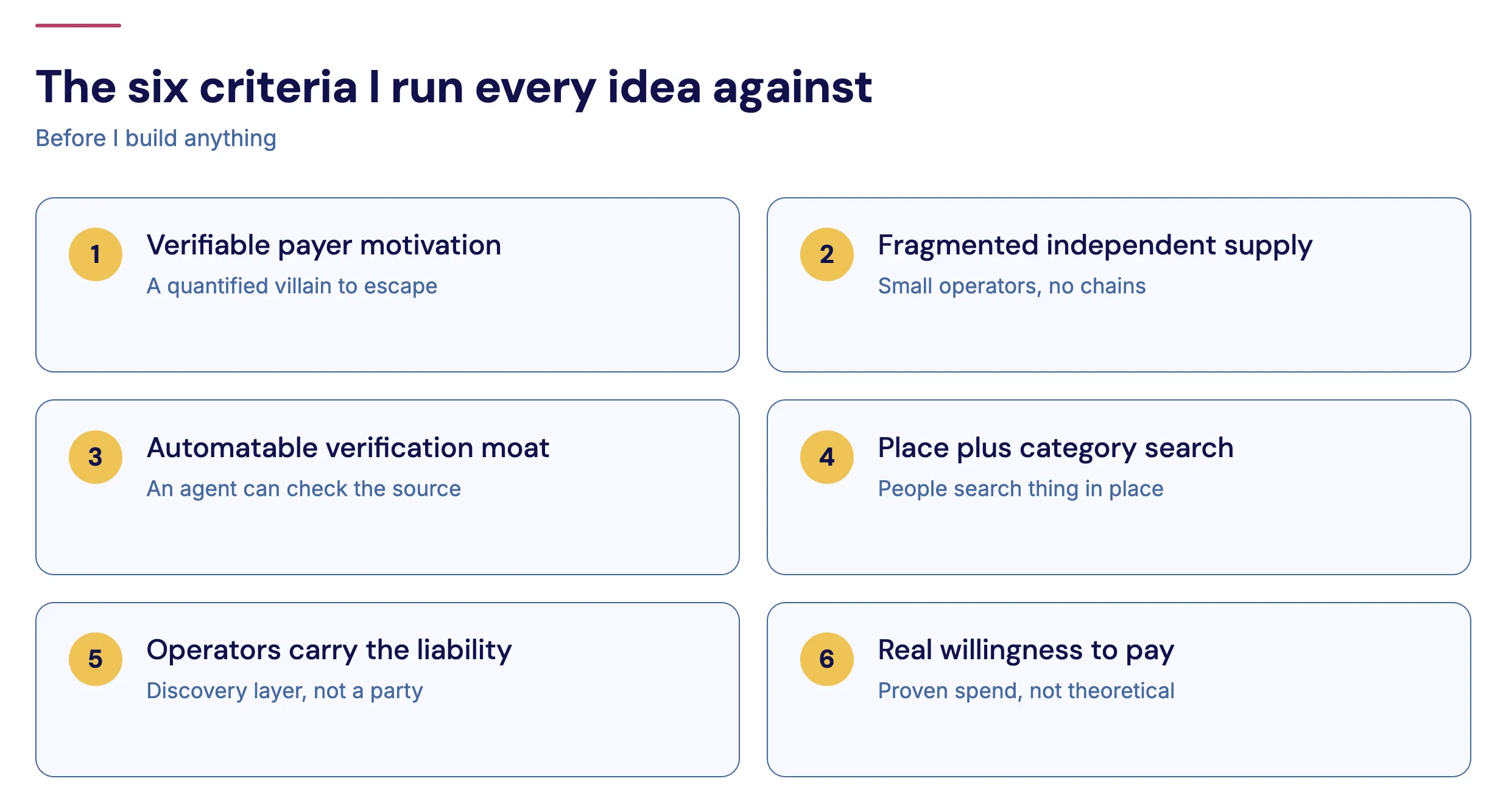
The six criteria I use before building assets with AI
Here’s the actual list I run every idea against, and feel free to take it and run with it. Read it for the shape rather than the specifics, though, because these are built for directories, a couple of other ideas I’m still fine-tuning, and the particular life I just described.
Yours should end up looking like something else entirely.
I’ve been pressure-testing directory ideas thanks to Fable (and my friend’s brilliant prompt), because AI makes it that much easier to make data-driven decisions and to build and deploy things. There is no way I would have even looked at a directory without being able to run it agentically.
1. Verifiable payer motivation. The businesses I’d list need a concrete, provable reason to pay... escaping a commission, a lead tax, a referral fee, or buying pure visibility. The stronger and more quantified the villain, the better. ($3,500 referral fees beat “more exposure” every single time.)
2. Fragmented independent supply. Lots of small independent operators, no dominant chains or franchises that already solve discovery for themselves. Ideally a pool of 1,000+ so there’s headroom to grow into.
3. Automatable verification moat. Something an agent can check against an authoritative source... state licenses, certifications, inspection records, commercial use permits. That’s what makes “verified” a real claim rather than a marketing term, and it’s what makes the whole thing survivable on an hour a week.
4. Place plus category search behavior. People have to naturally search “[thing] in [place].” For example: Assisted living in Sacramento, private chef in Park City, guided hikes in Sedona. That’s what makes programmatic SEO the acquisition engine instead of me having to build another audience.
5. Operators carry their own insurance and licensing. The liability lives with the listed business, never with me. I’m a discovery layer, not a party to the transaction.
6. Real willingness to pay. Not theoretical. Evidence they already spend money on visibility, or are demonstrably bleeding money to a middleman.
A friend of mine was interested in childcare/daycare, but it didn’t meet the criteria. Maximum pain on both sides of the marketplace, genuinely worth solving, and both sides were financially broken. Pain isn’t the same thing as a budget, and I’d rather learn that in one conversation with Claude than eighteen months in.
Like I said, half of these would be actively wrong for you if what you want is something hands-on that you love working in every day (I already have that with my personal brand). The point was never my list. The point is that a written filter turns “that’s a cool idea” into a defensible decision, and it’s the difference between building one thing that works and starting five things that don’t.
Five prompts to find the asset hiding in your experience
Paste these into Claude or ChatGPT in order when you want to try this. (Feed it real specifics. Vague inputs get vague outputs, and then people blame the AI.)
1. Build your filter before you build anything.
I want to define criteria for what kind of business asset actually fits my life before I evaluate any ideas. Interview me one question at a time about how I want to spend my time, how much time I'm realistically willing to give each week, what the money needs to do, what kind of work energizes me versus drains me, and what I never want to do again. After 8 to 10 questions, turn my answers into 5 to 7 specific, testable criteria I can score any opportunity against. Make them concrete enough to fail an idea, not vague values.2. Find what’s already in your experience.
I've spent [X years] doing [your work, industries, roles, the unglamorous specifics]. I want to identify recurring problems I already know how to solve... things people currently pay for, waste time on, or lose money on when dealing with them. Interview me one question at a time about my background. After 8 to 10 questions, give me 5 problems I'm unusually qualified to solve, and for each suggest what form a solution could take: a tool, a directory, a template set, a product, a service system.3. Score the ideas against your own filter.
Here are my criteria: [paste your filter from prompt 1]. Here are the 5 opportunities: [paste from prompt 2]. Score each one against each criterion, be genuinely harsh, and tell me which ones fail outright and why. For the top survivor, give me the strongest reason it's a bad idea before you tell me why it's a good one.4. Shrink it until it’s embarrassing.
I want to build [thing] for [specific person]. I'm building the ugly, tiny first version, not the dream version. What's the smallest thing I could ship that solves the core problem for one real user? Tell me what to include and, more importantly, what to cut.5. Audit what you actually own.
Here's how I currently reach my audience: [list your platforms, list, channels]. For each one, tell me what I genuinely own and control, what I'm borrowing from a platform, and what disappears tomorrow if that platform changes its rules or closes my account. Then give me the three highest-impact moves to shift more of it into things I own.The goal isn’t another project on the pile.
It’s one thing that keeps working while you’re doing something else entirely, and a written filter that lets you say no to the other four without second-guessing it for a month.
And I want to land somewhere other than the scanner, because the scanner is a small thing and this isn’t.
When I started my business, the whole dream was working from home. I was a young widowed mother with two small kids at home. 50-60 hr work weeks and a commute weren’t going to cut it.
That was it, that was the aspiration, and it was a good one. Then it became the digital nomad version once my kids were grown and on their own: work from anywhere, laptop somewhere with great weather (I can’t really complain about California weather, but summer for longer periods of time? Yes please!).
Both of those were really about location, about where you happen to be sitting while you do the work. What’s available now is a different thing entirely, because it’s about what you’re able to make.
I could have built directories fifteen years ago; it’s hardly a new idea.
But the work of it sounded tedious and honestly kind of heinous, all that manual research and data entry and formatting, and I would have hated every minute and quit somewhere around week three. So the idea isn’t what changed.
What changed is that the building is now the part I like most. I’m in genuine awe of what these tools do, and half the fun for me is the making and the figuring out, exactly like it’s always been, just with something different in my hands.
That’s what I want you to see in all of this.
Building assets with AI means you can make something shaped around the life you actually want, at whatever size that life is. Big and ambitious, if that’s what you’re after, or quiet and small, covering precisely what you need it to, so you can go do something else with your afternoon. There’s no correct scale here; there’s just the one that matches what you said you wanted when you answered those questions honestly.
This really is the opportunity of our lifetime, and I don’t say that lightly after eighteen years of watching things come and go.
You really can do this.
FAQ
Do I need to know how to code to build assets with AI?
No, but you do need to be willing to learn how to work with the tools. I build in Claude Code and VS Code, and I came to that from eighteen years of building WordPress sites, not from a computer science degree. The skill that matters most isn’t syntax; it’s being able to describe a problem precisely and recognize when the output is wrong.
What if I already have an audience and offers? Do I start over?
You don’t start over; you shift the ratio. An engaged email list you export regularly is already one of the strongest assets you can own, so the move is adding something that generates value without requiring you to publish that day, not tearing down what works. Prompt 5 in the list above is specifically for auditing what you already have before you build anything new.
How long does it take to build something like this?
Longer than a weekend and shorter than the nine months it used to take. The honest variable isn’t build time; it’s how long you spend deciding what to build, which is exactly why the filter comes before the build.
Will Substack’s AI detection flag my writing if I use AI?
Possibly, and detection tools in general have a documented tendency to flag formal or tidy prose and writing by non-native English speakers. Substack lets you write your own statement about your process and, as far as I can tell, lets you turn detection off for your own publication. Whether you engage with any of that is a separate question from whether you should.
The internet really went from BUILD YOUR PERSONAL BRAND to please explain your relationship with the robot before strangers run a scan on your paragraphs. What a time to be alive, Kim. 😂
There is a whole legal process that they ignored as well.
I apologize for this long comment in advance.
Substack's contract with its writers, dated August 2024, says Substack has to tell writers in writing at least 6 weeks before it adds any new vendor that handles our content. It's the EU Standard Contractual Clauses language Substack chose to adopt, and it's enforceable.
The same contract gives writers a 30-day window to object once the vendor list is updated.
The Wayback Machine captured Substack's Publisher Agreement on July 16, 2026, four days before the Pangram launch. Appendix 3 of the Data Processing Agreement lists 14 vendors. Pangram is not on that list.
For the six-week notice to have happened, writers would have needed a written heads-up on or before June 8, 2026. Nothing in the archived record shows that. I have not checked their website today. In my experience, they will eventually catch on and start updating shit as they move along.
The likely counterargument from Substack is that Pangram isn't a vendor in that sense because the scans are user-initiated. But their own launch post says writers can run Pangram on their drafts before publication. Unpublished writing flowing to a third party through Substack's platform is exactly what the vendor clause is written to cover.
It doesn't mean there was a breach, so I want to be super clear about that, and I am not an attorney lol, but there are enough legal loopholes for some legal team to question this entire charade.
Happy Friday Kim
Thanks Kim!
I am reading this now.
So glad you wrote this.