

When "AI-Powered" Is Just Internet Marketing in a New Hat
The internet marketing industry didn't evolve. It just added "AI" to the sales page

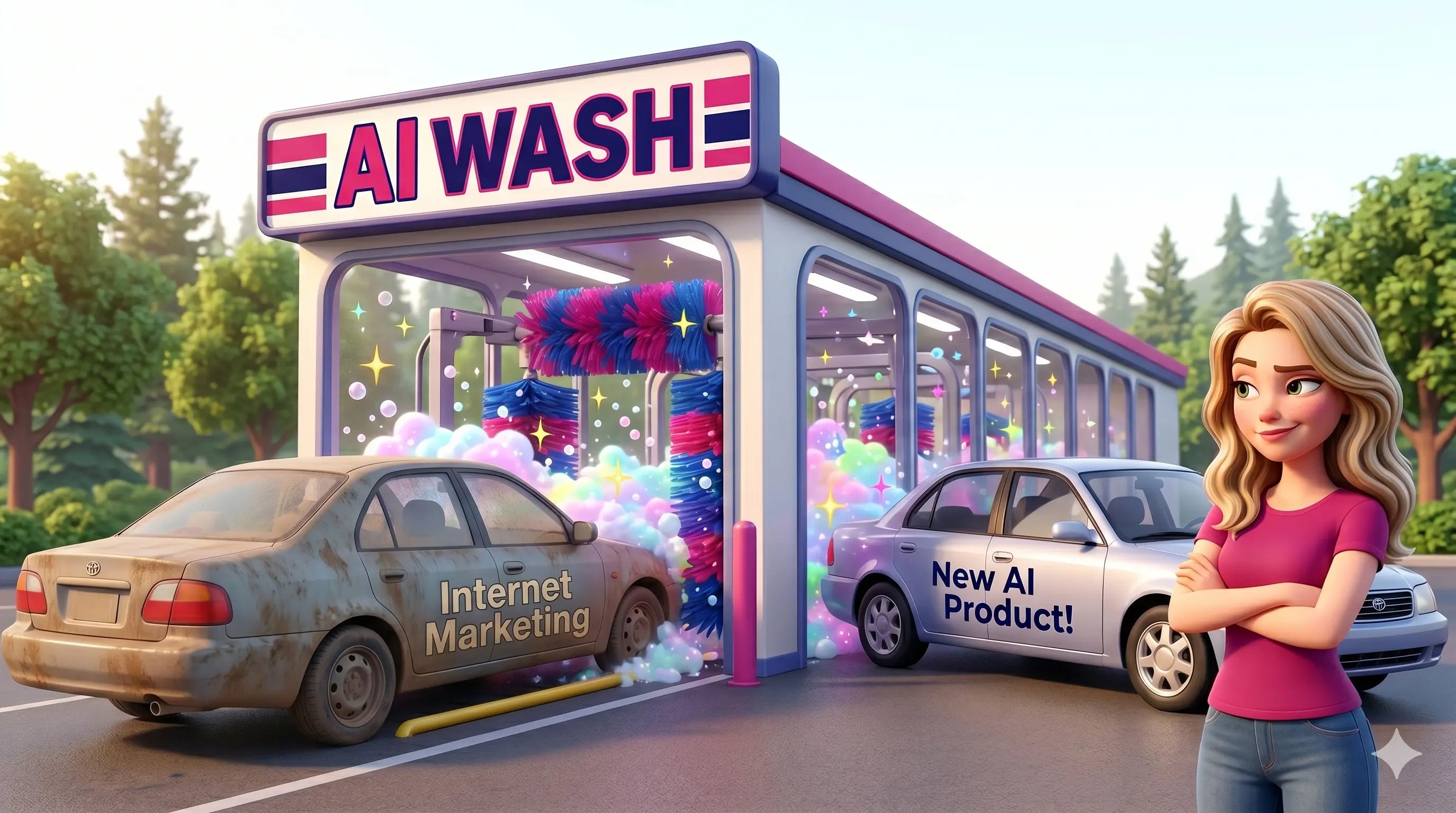
It’s been a while since I’ve paid any attention to what the “internet marketers” are doing. Once in a blue moon, a name or person will pop up, and I might think for a second, but I rarely, if ever, search to see what they’re doing. Maybe that’s a trauma response, lol.
I recently caught up with a friend of mine, and she told me she’d just watched a webinar… one of those 90-minute, high-production, perfectly scripted events that anyone who’s been in online marketing for more than five minutes has seen a hundred times. And what she described sounded a lot like what regulators are now calling AI washing… old marketing tactics dressed up in new technology language.
She described the bonus stacking at the end, the “challenge” format, a value pile so massive you’d need three lifetimes to get through it... all capped off with a countdown timer and a “this is your moment” closer (remember those? You get over $13k worth of stuff for only $2997!).
She was describing it, and I felt something I haven’t felt in a while… déjà vu so strong it was almost physical. Not because the content was familiar, but because the structure was, right down to the sentence cadence.
The webinar was Russell Brunson’s AI Secrets Challenge, selling a new platform called MarketingSecretsAI (dot com… I’m not linking to it). And my friend, who is newer to AI and wanted to learn how to use it in her business, sat through the whole thing and then called me to ask, “Is this real?”
That question has been living in my head ever since.

Hi, I’m Kim Doyal,
18 years building online, and I’m just getting started on the interesting part. I write about building real businesses with AI… apps, agents, systems, and revenue streams that don’t require me to perform for an algorithm every day.
No hype. No “10X your productivity” lists. Just what it actually looks like when a midlife entrepreneur decides to build in a way that works for her.
What is MarketingSecretsAI actually selling?
At its core, it’s a $97/month wrapper around an AI model you can access directly for $20, packaged with marketing frameworks from a decade ago.
But let me back up.
I went to the site, read the copy, looked at the screenshots, and I want to be fair here, because Russell Brunson built something significant. ClickFunnels has processed over $12 billion in user revenue, surpassed $265 million in annual revenue, and served over 150,000 customers. It changed how a lot of people sell online, and I’m not here to take that away from him.
But MarketingSecretsAI is, at its core, a wrapper around Claude Sonnet 4.6 (Anthropic’s model… the same one most of us use) with Russell’s marketing frameworks layered on top. There’s a “Brain” module, an “Attractive Character” builder, and “One-to-Many” content tools for emails, social, and presentations. It’s his existing intellectual property, fed into an AI interface, and sold for $97 a month with 1,000 credits.
You can access Claude directly for $20 a month.
The sales page says it’s “one AI to replace ChatGPT, Claude, Manus & Perplexity,” but it runs on Claude. It doesn’t replace it... It resells it, with guardrails that keep you inside Russell’s ecosystem.
And look, there’s nothing inherently wrong with packaging expertise alongside tools. That’s what a lot of us do. But the way it’s being sold... it felt like, “Oh, jeez. Here we go again.”
Why do these AI marketing tactics feel so familiar?
Because they are familiar.
The sales structure behind MarketingSecretsAI is the same challenge-funnel playbook that’s been running in the internet marketing world since roughly 2014, with “AI” swapped in where “funnel” used to be.
Here’s what I mean.
It’s the same 5-day challenge funnel with the free-to-VIP upsell at checkout, the “courses are dead, software is dead” proclamation (while selling courses inside software), and an 1,800+ training library positioned as a value stack alongside all the greatest hits... Dream 100, Soap Opera Sequences, the works (seriously? 1800+ training library?).
I’ve been in this space since 2008. I watched these tactics get built, and I used some of them myself early on, before I understood what they were actually doing. And what they're doing is selling to people who don't know enough yet to ask the right questions. The whole model depends on that gap... the distance between what the seller knows about the product and what the buyer doesn't.
That gap used to be massive.
In 2014, if someone told you they had a system for building online funnels, you probably didn’t know enough to question it. You couldn’t Google the underlying technology because it was genuinely complex and inaccessible.
In 2026?
The underlying technology is a chatbot you can sign up for in two minutes.
The tactics Russell is running... the bonus stacking, the artificial urgency, the “challenge” that’s really a five-day sales pitch... are the same ones from a decade ago. The only thing that changed is they swapped “funnel” for “AI” in the headline.
And here’s what I think is actually happening… he’s either out of touch with how fast things have moved or he’s counting on his audience being out of touch. I’m honestly not sure which is worse.
What is AI washing, and why should you care?
AI washing is the practice of overstating or fabricating AI capabilities in a product to make it seem more innovative than it is.
It’s become so widespread that the federal government is actively prosecuting it (we’ll leave any commentary about the federal government alone… 🙄).
I want to zoom out because this is bigger than one platform or one marketer.
Something I’ve been noticing across the industry is a scramble. Legacy software companies, established course creators, old-guard marketing platforms... they’re all doing the same thing. Bolting “AI-powered” onto existing products and hoping nobody looks under the hood.
And this isn’t just my observation.
The Federal Trade Commission launched an entire enforcement initiative called “Operation AI Comply” to crack down on companies making misleading AI claims. The SEC is going after it in the investment space too, and companies have been fined and sanctioned for overstating what their AI actually does.
And it’s not just happening in the world of marketing gurus. Wall Street noticed it first. Remember in February of this year, roughly $285 billion evaporated from legacy software stocks in what traders called the “SaaSpocalypse.”
The market was pricing in something the industry didn’t want to admit… that slapping AI features on top of existing SaaS products isn’t enough. AI-native companies, built from scratch with AI at the core, are rising at a pace that legacy platforms can’t match.
TechCrunch put it bluntly: legacy SaaS companies are “the incumbents” now, just as on-premises software vendors were the incumbents before SaaS disrupted them. The disrupted became the disruptable.
And here’s a stat that should make the “1,800+ trainings” pitch feel as hollow as it is… 44% of marketing SaaS licenses go completely unused. The problem was never that people didn’t have enough resources. The problem is they have too many, with no depth in any of them.
How do you know when an AI offer isn’t what it seems?
You already know.
If something felt off while you were watching that webinar or reading that sales page, that feeling is the signal, not the noise.
If you’re reading this and you’ve been in the crosshairs of one of these pitches (or several of them…), I want to tell you something.
Your instincts are correct.
If something felt off, it’s because something IS off. The tactics designed to short-circuit your judgment… the urgency, the social proof, the stacking, the “this changes everything” language… those aren’t AI innovations. Those are persuasion techniques from a pre-AI era, and they’re being deployed against people who don’t yet know enough to see through them.
That’s the part that bothers me.
Not that Russell Brunson is selling something… he’s a marketer, and that’s what he does. What bothers me is who it’s aimed at… people who are new to AI, who are curious and motivated, and who deserve better than a repackaged 2016 playbook at five times the cost of the actual tool.
What should you actually do instead?
You have two paths, and both of them are better than paying $97/month for a repackaged AI wrapper. You can learn to use AI tools directly and with real depth, or you can start building with them. Either way, the tools are right there, and they cost a fraction of what these platforms charge, and you can go deep with these tools… building custom instructions, creating your own systems, and developing actual skills that transfer across tools and don’t lock you into someone else’s ecosystem.
You don’t need someone else’s “Brain module.” You can build your own. (And honestly, it’s more fun that way. 😉)
If you don’t want to build things, that’s completely fine too.
But you should still learn how to use these tools with intention, going deeper with what you already have so that when someone tries to sell you a wrapper at a 5x markup, you can see it for what it is.
And if you’re a builder or creator watching this unfold... pay attention to what you’re feeling right now. If you’re looking at the gap between what these legacy players are selling and what’s actually possible, and thinking “I could build something better than this”... you’re probably right.
That instinct isn’t arrogance… It’s pattern recognition. The fact that you can see the seams in the old playbook means you’re already operating at a level that most of these packaged solutions are designed to keep people from reaching.
While they’re running challenge funnels, you can be building something real.
How can you evaluate an AI offer before buying?
Use this prompt.
Paste it into Claude, ChatGPT, or whatever LLM you use, along with the URL of the sales page, and it will score the offer across five categories, helping you make an informed decision rather than an emotional one.
This isn’t about being cynical; it’s about being informed.
I'm evaluating an AI-powered tool/course/platform before purchasing. Please analyze the following sales page and score it across five categories on a 1-10 scale (10 = excellent, 1 = concerning). Give me a total score out of 50 and a clear recommendation.

Here's the sales page URL: [PASTE URL HERE]

Score these five categories:

1. Underlying Technology (1-10)
What AI model or technology does this actually run on? Is it proprietary or a wrapper around existing tools (Claude, ChatGPT, etc.)? What would it cost to access the underlying technology directly? How significant is the markup?

2. Value vs. Volume (1-10)
Is the offer deep and focused, or is it padded with volume to create perceived value? (Example: "1,800+ trainings" sounds impressive but often signals a content dump, not a curriculum.) Would a buyer realistically use even 20% of what's included?

3. AI Integration Authenticity (1-10)
Is AI genuinely core to the product, or is it bolted on as a marketing angle? Could this product exist without the AI label? Would removing "AI" from the branding change what the product actually does?

4. Independence vs. Dependence (1-10)
Does this teach transferable skills the buyer can use anywhere, or does it lock them into a proprietary ecosystem? If the buyer canceled tomorrow, would they walk away with usable knowledge and skills, or just access to a platform?

5. Pricing Transparency (1-10)
How does the cost compare to accessing the underlying tools directly? What is the buyer actually paying for... the technology, the training, the community, or the packaging? Are there hidden costs (credit limits, usage caps, upsells)?

After scoring, tell me:


What could I build or access myself for less?
What, if anything, genuinely justifies the premium?
What red flags do you see in the sales tactics being used?
I ran this prompt on MarketingSecretsAI's sales page while writing this post (again, it’s marketingsecretsai dot com). I'll let you try it yourself and see what you get. 😉
Why should you trust your gut over the sales pitch?
My friend called me because something felt wrong. She couldn’t name it yet, but she could feel it. That instinct, the one that makes you pause before entering your credit card, isn’t imposter syndrome, and it’s not “resistance to investing in yourself” (which is what these marketers will tell you it is).
That’s discernment.
The internet marketing industry trained a whole generation of buyers to override that instinct. “If you’re feeling resistance, that’s your sign you need this.” What a convenient thing for someone selling something to say.
I think we’re entering a new era where the people who win aren’t the ones with the best funnels or the most aggressive urgency tactics. They’re the people who actually understand the tools, build real things with them, and share what they’re learning along the way.
The old playbook is showing its age, and AI washing is just the latest symptom. The people still running it might not realize it yet... but their audience is starting to.
You don’t need someone’s AI-wrapped marketing system from 2016. You need 20 minutes with an actual AI, a real question, and the willingness to figure it out.
That’s always been the real secret.
Questions worth asking
What is AI washing?
AI washing is when a company exaggerates or misrepresents a product's AI capabilities to make it appear more innovative than it actually is. The FTC launched “Operation AI Comply” to crack down on this practice, and the SEC has taken enforcement action against investment firms engaged in it.
How do I know if an AI tool is a wrapper or genuinely innovative?
Ask one question: What model does it run on? If the product is built on top of Claude, ChatGPT, or another publicly available model, you can access that model directly for a fraction of the cost. The value of a wrapper only justifies a premium if it adds something you genuinely couldn’t build yourself… and with today’s tools, that bar is much higher than most sellers want you to realize.
Is it always bad to pay for packaged AI tools?
Not at all. There’s nothing wrong with paying for genuine expertise, curated workflows, or community alongside AI tools. The red flag is when the packaging uses high-pressure sales tactics, inflated “value stacks” of content you’ll never use, and misleading claims about what the AI actually does. The “Before You Buy” prompt in this post will help you tell the difference.
What should I use instead of AI marketing platforms?
Start with the AI tools directly... Claude, ChatGPT, or Gemini. A $20/month subscription to any of these gives you more capability than most $97+ “AI-powered” platforms. Spend time learning how to use them well, build your own custom instructions, and develop skills that transfer across tools instead of locking you into someone else’s ecosystem.
The era of needing someone to package AI for you and sell it back at a markup is ending faster than most of these companies want to admit.
What’s replacing it is honestly better… direct access to powerful tools, communities of people learning and building in the open, and a growing understanding that the real skill isn’t knowing which platform to buy. It’s knowing how to think clearly about what you’re trying to build and then using whatever tool gets you there.
That shift is already happening. And if you’re reading this, you’re probably already part of it.
If someone declares "this changes everything" I usually run the other way! I have not heard the term AI-washing and it's fascinating (although highly annoying, lol!). So glad your friend checked-in with you before signing up!
I heard recently of a tech company that was interested in a particular AI product, until they learned the "AI" was a team of hundreds of under-paid workers overseas creating the illusion of AI as the product wasn't yet properly integrated with it behind the scenes. Sounds like this situation is actually quite common in various forms! 😅
This is a brilliant breakdown of the 'AI-washing' scramble. I share your annoyance that these 'products' are aimed at beginners. I understand why people are tempted to buy a package, it takes away the stress of having to go out and find the information for yourself. But, those ridiculous bonus packages merely add to the cognitive stress and guilt because you couldn't find time to use them all if you lived two whole lifetimes.
My advice to any beginners would be take out a subscription to Claude/ChatGPT/Gemini, find a creator you align with and start testing their methods/workflows. That way you learn exactly what you need, when you need it.
Thank you for giving people permission to trust their own friction instead of paying $97 a month to ignore it.