

When Will Your Feed Become a Ghost Town?
The moment always ends. Here's what's left when the crowd leaves, and why it was never the platform to begin with.

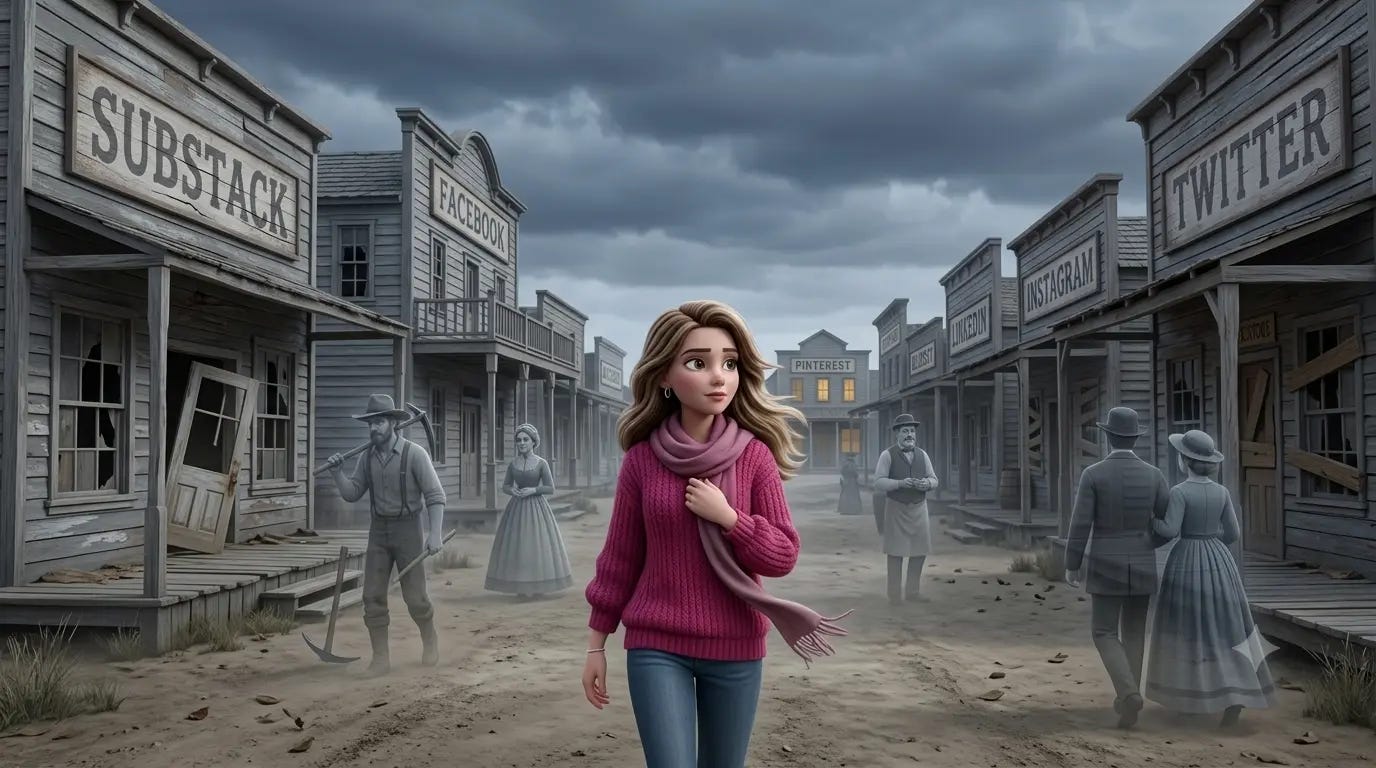
I live in Gold Country in Northern California (Lake Tahoe is one hour northeast of me and Sacramento is an hour southwest of me... if that helps at all, lol).
Twenty minutes up Highway 88 from me is a town called Volcano. It’s teeny... around two hundred people, tucked into a little bowl-shaped valley. There’s actually no volcano there, but the little bowl-shaped valley looked like the crater of a volcano, so that’s what the gold-miners called it. I hadn’t actually been to Volcano until my Dad and I went for dinner last December at one of the two old hotels still standing on the main street, the St. George. The kind of place you drive through without thinking twice (confession: I had never been to the town of Volcano, even though my parents retired up here in 2005, and I’ve been living with my 82-year-old father for a couple of years now).
What’s interesting, though, is that 170 years ago, Volcano had more than 10,000 people. It also had California’s first private law school and its first astronomical observatory. A whole main street of people who were certain they were standing in the center of everything... because for a minute, they were.
Then the gold ran thin, and the crowd did what crowds do.
They left for the next strike. A lot of these foothill towns didn’t just empty out... people tore the buildings down and hauled the lumber off to the next promising claim, dismantling a whole town to carry it to the next boom! Can you imagine dismantling an entire town?!?! And by hand… they hardly had heavy machinery to do the work.
Here’s the thing though... Volcano isn’t really a ghost town.
It didn’t die... it just emptied of the crowd and the moment, and what’s left today are the couple hundred or so people who actually want to be there, and two hotels still serving dinner (I’m sure there are a few other businesses in Volcano, but it was night and I wasn’t really paying attention).
I’ve been thinking about Volcano and all the other gold-mining towns with similar stories (in my research, I learned about Bodie, California, a few hours away, which is an actual ghost town. You can walk through the abandoned buildings... might have to do some exploring!).
Mostly because I keep watching people build their whole business on rented land and call it home.

If you’ve ever felt the quiet dread of a platform changing the rules on you… the reach that vanishes overnight, the sense that you’re renting an audience you thought you owned… this piece is for you. There’s a way to build that doesn’t leave you at the mercy of an algorithm’s mood, and it starts with seeing the trap clearly.
I’m Kim Doyal. I’ve been building online for 18+ years, and these days I build real businesses with AI. Apps, agents, and revenue streams that don’t require me to perform for a feed every day. Stick around; the rest of this is the part that actually changes how you build.
The month everybody started policing each other
It’s been a busy few weeks on the platforms.
We all watched Substack roll out an AI detector, an integration with Pangram that lets readers scan a post and get a percentage of how “human” it supposedly is. LinkedIn shipped a button to flag “AI slop.”
Everywhere I look, there’s a new little instrument for surveilling measuring whether you’re doing it right, and a fresh round of people feeling righteous about who’s doing it wrong. 🙄
My friend Finn Tropy wrote a piece this week that cut straight through the noise, and you should read it. His angle is the honest one most of us don’t want to look at: the reading side of this whole relationship is quietly going agent-native.
He went into his own subscriber list and found 109 people out of 730 who have opened every single email he’s ever sent and clicked nothing, ever. Substack rates most of them a perfect 5 out of 5 for engagement. His point lands hard... your dashboard can’t tell the difference between a devoted reader and a pixel firing on autopilot, and your metrics have been partly fictional for years.
Go read Finn’s article. He’s doing the ground-level forensics. “I don’t read your newsletter either.”
I want to stand next to that and say something bigger about where you planted your business in the first place.
But before we get into that... I want to be crystal clear about something: Build your business wherever it suits you; this isn’t about judgment, criticism, or calling anyone out.
This is simply about the fact that there are other ways to grow a business if writing and creating about platforms on said platforms isn’t for you, but it feels like you have to participate in a system that isn’t what you want or sucks the life out of you.
You don’t owe anybody an explanation
Let me get this part out of the way, because it’s underneath everything else.
You don’t owe anyone an explanation for how you work, what tools you use, or where you show up. Not a detector, not a badge, not a comment section. If you show up with intention and integrity and do the best work you can with what you’ve got, that is the whole assignment.
The detector-and-slop-button energy assumes the problem is people sneaking something past you. In my experience, that’s rarely the problem. The problem is noise and the pressure to perform according to the platform’s rules instead of doing the actual work. I’m not interested in that. I’m interested in building things and getting them in front of the people they’re for.
I have a friend who has scaled to multiple six figures without any social media or content (she validated everything organically first, and the scaling happened after that).
Read that again... because it flips everything on its head.
She dialed in her business, content, and strategy with organic first, then created a self-liquidating offer (meaning the offer, a live $10 workshop with her, covers the ad costs), to a paid community.
She launched that in the fall of 2020. Her first run of this brought in $46k. At the time, her paid community was $17. Within a year, she started offering a $5k certification. Fast forward to today, and her community is $97 a month; she’s moving from certification to licensing (with an annual licensing fee), and has hired the Hormozi’s Acquisition team to dial all of this in (they were the ones who suggested the licensing).
I’m not sharing any of that to impress you... And for what it’s worth, the Hormozi’s aren’t my cup of tea, but I won’t deny what they’ve created and that they’re good at what they do.
The point is to show you that you do not have to feed algorithms to create what works for you.
*Side note: She’s still running the SAME $10 workshop, which, my guess is, is on-demand now; I forgot to ask her when we spoke a couple of weeks ago. You don’t have to keep reinventing products and offers. Dial one in and get it in front of new people.
She also spent a lot of time on her message, the offer, running the workshop live, and listening to her customers. Her niche is not in the ‘creator’ space.
Moving on.
Of course they answer to investors first
Now the part I’ll actually take a hard position on.
Every one of these platforms answers to investors first. That’s not a betrayal, it’s a fact. Once you see who they’re built to serve, none of the moves surprise you, and you stop taking them personally.
This doesn’t mean anything about the people or communities you’ve connected with on any platform either. Remember, I’m referring to the corporations here. You can both love the people on a platform and not like the company behind it. Two things can be true at the same time. Plus, if I had to take a stance on tech companies, I couldn’t run my business.
Take a look at Substack: The bestseller badge, the constant push toward paid subscriptions, the recommendation engine that decides who gets seen, the video, the podcasting, and the live features bolted onto what started as a clean little writers’ space piggybacking off Medium... that’s not a platform losing the plot. That’s a platform doing exactly what a venture-backed platform does. It needs you producing and on-platform, because an engaged you is inventory.
Substack took off, and the reward for taking off is that it’s become another social platform.
And when the incentive to keep something alive disappears, the platform disappears (or becomes a shadow of itself), no matter how big the name on the door. Remember Google+? All of Google’s money, all of Google’s infrastructure, all of Google’s reach, and... buh-bye. Because the incentive to keep it wasn’t there (not to mention that it wasn't remotely intuitive).
If Google can’t keep a social platform alive on purpose, I’d think twice before betting my livelihood on any single one staying exactly the way I found it.
On the flip side, whenever I mention Facebook, people are shocked that anyone is still there (I push content to my business page, and will implement a cheap paid ad strategy to build a retargeting list, before turning on a structured paid campaign).
Do I want to spend time on Facebook? Hardly... but I have first-hand evidence that paid acquisition on Meta platforms works. There are only so many hours in the day, and if I can target exactly who I want to get in front of with Meta ads, I’d rather do that with concrete data rather than more content (i.e., more than I’m already doing).
This isn’t a Substack takedown. I like Substack and the people I’m connected to. I’m making a point about the whole neighborhood.
During a gold rush, sell shovels
Back to the foothills for a second.
The people who got rich in the Gold Rush mostly weren’t the miners. Sam Brannan became California’s first millionaire without ever panning for gold. He bought up every shovel, pick, and pan he could get his hands on, then ran through the streets of San Francisco, waving a bottle of gold dust and yelling “Gold! Gold!” and sold the tools to everyone who came running (feels a bit like billionaires achieving billions through government subsidies 🤔).
During a gold rush, sell shovels.
We’ve all heard this.
I keep seeing the same shape now. A big chunk of the people making real money on Substack are the ones teaching people how to make money on Substack. That’s a completely valid niche, and I’m genuinely not knocking the people doing it well. Selling shovels is honest work.
What I can’t stand is the format it curdles into.
The listicle garbage. The “7 Ways to Get Rich With Claude That Nobody Tells You” fluff, shallow, recycled, wearing whatever niche hat over the same tired internet-marketing playbook I watched go around fifteen years ago.
YouTube is notorious for this... “5 INSANE Claude Secrets to $10k a month!” Want to succeed on YouTube for the long haul?
Skip the bullshit.
Unless you want to become a “YouTuber”... You’re better off creating valuable content that attracts your ideal customer... and then patience, Young Jedi.
So here’s my line, and I’ll hold it: I have all the grace in the world for people, and none for the genre. Most people are doing the best they can with what they know. If you’re new and you’re mimicking the loudest thing in the room, that’s not a character flaw; that’s the on-ramp. But the shovel-seller playbook is old, and it’s shallow, and you can feel it.
One more thing about Brannan, because it’s the whole piece in one man.
He got rich selling the dream to the dreamers, and he died broke, in poverty, his body unclaimed for a year. Even the shovel-seller ate his own lotus flowers.
Stay with me... I’ll get to the lotus flowers.
The moment ends. The people don’t.
Here’s my actual prediction, and I don’t need a crystal ball for it.
The platform doesn’t have to die for you to pay the price. The moment ends. The shine wears off, the special feeling flattens into generic social, the wheel turns, and the crowd that was here for the shine drifts to the next shiny thing. That’s the part people miss. It isn’t a crash... It’s a slow, quiet emptying, exactly like a foothill town when the easy gold runs out.
And your actual customers? They don’t leave when the moment does.
They were never there for the moment.
Remember my point about running Meta ads? This is a perfect example. Of course there are still people on Facebook, and your customers are there. It’s just that “the moment” ended years ago... the “cool” kids left, the cultural buzz moved on, and the buyers stayed right where they always were. The people who chased the buzz to the next platform were never your buyers in the first place.
They were the crowd.
*I’d go so far as to say Facebook and Instagram present as social platforms, but really they’re ad platforms. Just my two cents.
Producing and publishing does not automatically make you profitable.
Read that one twice, because it’s the whole thing.
You can put out genuinely great work consistently for years and still not have a business if you never stop to look at the underlying model (if, in fact, that’s why you’re publishing in the first place. I know not everyone on Substack is trying to build a business).
The lotus flowers
If you’re not familiar with the lotus-eaters, here are two examples (not ashamed to say I knew the Percy Jackson reference and not the Odyssey, lol).
In the Odyssey, Odysseus lands his crew on an island where the locals eat lotus flowers, and the second his men taste them, they forget all about going home. They’re happy. They’re content. They lose the thread completely, and Odysseus has to physically drag them back to the ships while they weep about leaving.
The Percy Jackson example is when Percy and his friends went to Las Vegas, ended up in a casino where they were handing out free lotus flowers, and lost a week of their lives in blissful oblivion… almost missing the deadline for the mission they were there for in the first place.
That’s the echo chamber, and it’s the most dangerous thing about a genuinely great community.
Substack has one of the most engaged, warmest communities I’ve seen anywhere. I mean that. There are people here I truly love reading. There’s real connection, and real generosity. And that warmth is exactly what makes it a trap when you’re trying to build a business on top of it. Friends support friends who support friends who support friends. The notes get liked, the restacks roll in, the comments are kind, and it feels like traction (and I will keep doing that for the people and publications that matter to me, echo chamber be damned).
It reads like validation.
But peers aren’t usually customers. Peers cheer for you. They don’t buy from you. Those are two completely different currencies, and the platform is delighted to pay you in the one that costs you nothing (except your time), because it keeps you posting.
I lived this exact movie in the WordPress space. Years of putting out content my peers loved, which got shared within the same circle of people who were never going to be my customers, because they were my colleagues. It took me too long to realize I was making content for the green room rather than the audience.
The lotus flowers taste amazing.
That’s the problem.
A personal example
As I said, I’m not leaving Substack (at least not for the foreseeable future; I know enough to ‘never say never’).
But if and when I want to, the exit door is right there, and I’m the one who built it. I’ve got an automation that pipes every new subscriber off the rented land and onto ground I own. Years ago I used to send daily emails, and I know in my bones what email can do when you actually use it. So capturing the list was never my problem. That part’s solved.
What I’ve taken my time about is everything underneath it.
Here’s the honest version, and it’s less flattering than “I’ve been too busy.” For a long time I haven’t been fully clear on what my own back end should even look like, and I’ve stayed quiet about it rather than pretend I’ve got it all wired up.
I recently found a brand new email tool that is genuinely beautiful, and I wanted it. It natively connects to the LLMs and comes with skills to hand off to streamline things. But choosing it would have handed me the entire job of deliverability... the sending reputation, the compliance, the unglamorous plumbing that decides whether your email lands in an inbox or a spam folder. (My current platform quietly handles all of that, which is the least sexy and most valuable thing it does.) And nothing in me wants to become my own deliverability department.
So I sat with it instead of lurching toward the prettier option.
Same reason it took me a while to switch on a paid tier... it has to actually work for me, not just look good in a screenshot. Getting your infrastructure right is slow, quiet, genuinely unsexy work that gives you no dopamine at all, which is exactly why it’s so easy to skip (not to mention that moving email platforms is a HUGE pain in the arse...).
That’s the real shape of “own your audience.”
It isn’t a single afternoon in which you export a list and declare victory. It’s an ongoing set of decisions about what you’re willing to depend on and what you’re not. (For me, that includes three more posts coming in my traffic series, on finding your own people instead of waiting for a recommendation engine to hand them over.) Email still works. It’s just quieter than the feed, and the quiet is the whole point.
I’m so over the noise and hype.
None of this is a breakup letter to a platform.
I’m still here, and I love it. I like the people here more than any other corner of the internet I spend time in. Staying isn’t the problem. The trick is staying awake while you stay: noticing what you’re actually standing on, who the platform answers to when it makes its choices, and whether the momentum you feel is a business or just the notes lighting up on a particular day.
Eat the lotus flowers if you want to; I probably will too, as long as you don’t lose track of the fact that you’re eating them and you keep one eye on the door.
The platform has never been, and never will be, the asset.
You are.
Your experience, the people who already trust you, the business only you understand well enough to build... that’s what you carry from strike to strike, and no detector scans it, no recommendation engine grants it, no algorithm change can take it. The platform is just where you pitched your tent this year.
The gold was always you (Yes, I totally feel like Glinda the Good Witch telling Dorothy she “always had it in her” to go home).
And if you’re not even publishing yet, if you’re still deciding where to plant... that’s not the sad seat in this story, it’s the good one. You choose your ground before you’re ever standing on someone else’s.
And if you want proof that every single one of these moments is a cycle, here it is: the people who own MySpace just announced they’re bringing it back. 🤯 Not ironically... On purpose. And the entire pitch is no algorithm, a chronological feed, real friendships, music. The exact opposite of everything the current platforms optimize for. The wheel turned so far that the thing everyone abandoned twenty years ago is now the fresh idea.
Which naturally triggers the question of “How will they monetize” a platform for the people and not investors? I’m not holding my breath.
Crazy times.
So here’s my question for you, and I actually want to know. If an agent could extract everything valuable you’ve ever published without a human ever reading it, and the buzz on your favorite platform went quiet tomorrow... what exactly would you still have?
The Volcano story is such a good way into this.
I’ve been thinking about this a lot lately, especially with all the AI/platform nonsense.
I was chatting with my brother a lot this weekend. Kim, my brother, is doing really well with his social media marketing business in the Caribbean, and he doesn’t even have a LinkedIn account. No Facebook. No Instagram. He hates putting himself out there, but his business is built on referrals and handshakes, which is pretty much how I’ve built my consulting business too.
I love writing. I love the people here, but these platforms are a piece of work, and I am no longer encouraged to build here.
And I laughed at the lotus flowers because… yep. 😂
The community makes me forget the whole point 10 hours later.
I could go on about this stuff for hours, but I would be rambling.
Happy Monday, Kim.
How was your weekend otherwise?
I think you and I could talk about this stuff forever! So many great truths in this piece, some of which I've unfortunately forgotten.
To answer your question, I don't know what I have- probably jack shit because I don't know what value I have anymore other than personal stories. Everything I learned, knew, and taught is now at the mercy of AI and the 10-second response, and in so many ways, I don't even care. It's an existential crisis at the moment.