

You Already Know How to Do This (AI Just Makes it Easier)
The foundational work that makes AI actually useful instead of just fast


I was ten years old when I got my first 10-speed bike.
It was a Huffy, and since it was 1980, it was sporting lovely orange and brown colors (can’t believe I found an image of it online!).

My birthday is in July, and my parents threw me a surprise swim party (my Mom made everything a little more magical). My Mom was down at the neighbors and my Dad was taking us down to “the pool” (the local neighborhood swim club). She asked us to stop by the neighbors’ on the way to the pool.
We went in through the side gate, and as soon as we turned the corner, I heard, “SURPRISE!”
Our neighbors had a pool, and my parents asked if they could host my party there. I had no idea.
A little later in the party, I walked into the garage to get a soda, and there it was—this beautiful new bike with a big red bow just waiting for me. I remember that moment so clearly.
Not because of the party or the cake, but because of what my parents had done for me and what that bike represented.
Freedom.
Suddenly, I could go anywhere. I could ride to the pool myself for swim team practice, ride down to “the store” to get a pack of gum, or ride to school. We would also “double ride” (a friend could sit side saddle on the middle bar or sit on the seat while you stood and pedaled 😂).
But here’s the thing about that bike: it didn’t teach me how to ride (I learned that on a banana seat bike!).
I already knew how to balance, pedal, and steer. The bike just took me farther, faster.
That’s what AI is supposed to be.
Not training wheels. Not a replacement for knowing how to ride. It’s the tool that amplifies what you already know how to do, but only if you actually know how to do it first.
Right now, most people are using AI backward (and for what it’s worth, it’s easy to get caught in that cycle, pun intended).
The Problem: You’re Asking the Bike to Ride for You
When the output is “meh”…
Telling AI to write your About page based on previous copy (i.e., old), or a generic description of who you are and what you do. Or telling it to create content, copy, or marketing materials with minimal input or a simple directive prompt.
It’s like handing someone a bike and expecting them to magically know how to ride just because they’re sitting on it.
And the output? That’s the “meh” that I’m talking about. It sounds like everyone else because AI is literally averaging millions of voices as opposed to amplifying yours.
I’ve been guilty of this too.
I have plenty of original content in my own voice, and because I could upload it for AI to reference, I thought, “good to go.” I found myself cranking out content without stopping to ask the most important question: What am I actually building here?
Especially as my business has evolved this year to a focus on AI.
It’s so easy to get caught up in the latest AI tool, the newest feature, the next shiny thing. It feels productive. You’re creating content, building pages, and writing copy. But if you stop and actually READ what you’ve created... does it sound like you? Does it represent what you actually believe? And more importantly, will it resonate with the people you hope to attract & connect with?
Or does it sound like a really well-written version of everyone else? 🤔
AI makes it dangerously easy to skip the most important work, what I call the “behind-the-scenes” work. The work that at first doesn’t feel productive, but is actually the most important (and just a reminder… people have been creating for thousands of years without having productivity systems).
It doesn’t feel productive because it’s a process - not a one-and-done, which is what too many people expect AI to be.
I was reminded of this when I read an article by
about world-building.I had first heard the term world-building from the brilliant André Chaperone (where are my veteran internet marketers?). I couldn’t find his original article, but he’s back and still talking about world-building. Check out his manifesto here… so good.
(And yes, I said world-building. Stay with me here. I’m deep in this work right now—building out what I’m calling my world, the spaces within it, the experience I want to create. It’s more challenging than simply prompting AI to create something. But it’s soooo fun and incredibly valuable.)
The Foundation You’re Skipping
Before you ask AI to touch anything… before you write another prompt, generate another post, or create another funnel (I know funnels work and sell, but jeeze-louise they feel ‘tired’) - go deeper and ask better questions.
Your Values
What three things matter most when you create?
For me, I want my content to do at least one of three things:
I want to entertain people
I want them to learn something
I want to speak to the heart
These aren’t brand guidelines. These are non-negotiables. The things I refuse to compromise on, no matter what format I’m creating in or what AI tool I’m using.
What are yours? What actually matters to YOU when you create something?
A great prompt to go deeper into this is to ask AI to ask YOU questions to help you define your values in your business.
Who Lights You Up
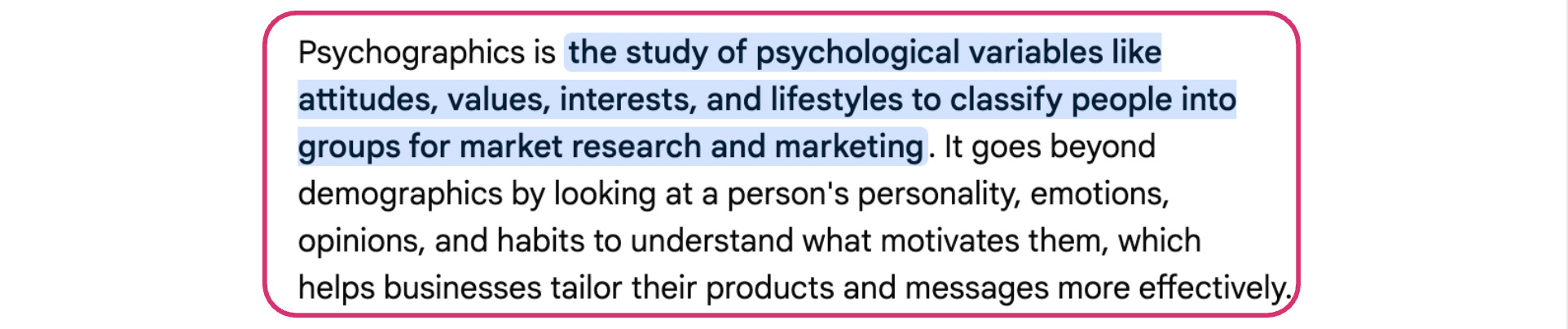
This isn’t about “ideal customer avatars” or demographic profiles (personally, I love focusing on psychographics).
Who are the people you genuinely WANT to connect with? Who makes you excited to show up and do the work?
And just as important: Who are you absolutely done trying to please?
For me? It’s no surprise that I’m done with the bro-marketer, hustle harder crowd. I rarely see any of that stuff anymore (amen for curating and unsubscribing). Mostly, I’m done with doing anything that I don’t enjoy.
Knowing who you’re NOT for is just as clarifying as knowing who you ARE for.
Your Version of the Bike
What’s the moment of freedom you’re helping people reclaim?
For me, it’s about building businesses on your own terms. It’s about floating in the pool, reading novels most afternoons during the summer. It’s about never setting an alarm clock again. It’s about creating a life where you don’t need anyone’s permission or approval.
What’s YOUR version of that?
What capability, freedom, or sovereignty are you helping people remember they already have? (sovereignty is my new favorite word - as in the “self-governing” sense)
What You’re Unwilling to Do
I’ve learned that knowing what you WON’T do matters more than what you CAN do.
What makes your chest tighten? What creates that physical reaction of “absolutely not”?
For me, it’s being on demand for anyone or anything, muting my voice to be more palatable, apologizing for my beliefs, or watering down my opinions (something that seems to hit a lot of women after 50).
What are the things you’re unwilling to do, even if they technically work? Even if everyone else is doing them?
These aren’t just philosophical questions. These are the foundations that make AI actually useful, rather than just fast.
What Changes When You Do This Work First
Once you have these foundations clear, everything shifts.
AI stops being a shortcut and becomes an amplifier.
Instead of asking AI to figure out your positioning, you bring your clarity and ask it to help you articulate it twenty different ways (or use one of
‘s prompts to get AI to be brutally honest with you, not just validate what you want to hear).Instead of generating generic content, you have a point of view, and AI helps you express it consistently across formats.
Instead of creating hollow copy, you know your values, and AI helps you apply them at scale.
*TIP: As you’re doing this work, have AI explain things to you as though it’s your mentor. I have learned a ton about building with AI when I run into errors and Claude or Gemini explains to me what the issue is and how to fix it! Not because I want to be a coder (never gonna happen, lol) - but it helps me understand the building process.
Here’s what this actually looks like:
You’ve figured out your content values → AI helps you ensure every piece of content includes one or hits all three, no matter the format.
You know your world → AI helps you build the map, create the visuals, and develop the language that brings it to life. Call it out when it gets lazy (because it does).
You’re clear on who you serve → AI helps you speak to them specifically instead of writing for “everyone” (which we all know has never worked).
You have core stories → AI helps you adapt them for different platforms, audiences, and contexts without losing what makes them yours. Have it ask you questions about your life to pull those stories out if you’re drawing a blank.
AI becomes your collaborator, not your replacement.
Your Superpower
Here’s what I’m hoping to remind you of: you already have the exact skill AI needs most.
And it’s not just technical knowledge.
It’s this: the ability to trust yourself, bring all your skills to the table, and do what works for YOU.
You learned to ride that bike without anyone helicoptering over you. You navigated road trips with paper maps (or, if you’re a California Gen X like me, the Thomas Guide). You built things from cryptic instruction manuals. You solved problems when there was no Google, no YouTube tutorial, no “just ask AI.”
You had to think for yourself. Figure things out. Try, fail, adjust, try again.
You’ve got this.
Because AI doesn’t need you to be technical. It needs you to be CLEAR. To know what you want and to think critically about what you’re building.
People don’t struggle with AI because they’re lacking technical skills. They struggle because they haven’t done the “behind-the-scenes” work. I remember when I started studying and learning how to write copy. It was incredibly tedious (writing 20+ headlines to hopefully come up with one good one), but again, it gave me a foundation and understanding. So when AI spits out “AI headlines,” I know enough to tell it it’s lost the plot (anyone else enjoy telling AI it’s lost the plot?).
The Work That Matters
So here’s what I’m asking you to do:
Before you ask AI to write your next post, create your positioning, or build your funnel...
Stop.
Do the human work first.
Answer those foundational questions to define your values (as they relate to your business). Get clear on who lights you up and who you’re done trying to please. Name your version of the bike, that moment of freedom you’re helping people reclaim.
Know what you’re unwilling to do.
Build your world BEFORE you ask AI to help you describe it (I highly recommend both Andi’s article, which will help you with Substack growth, as well as André’s on world-building).
And here’s the beautiful irony: once you do this foundational work, AI becomes exponentially more useful. Instead of giving you generic outputs that sound like everyone else, it helps you amplify what’s uniquely yours.
Your voice. Your values. Your world.
That’s when AI stops being a shortcut and becomes exactly what it was meant to be: the bike that takes you farther, faster.
But you have to know how to ride first.
And you already do.
You’ve been doing it your whole life.
I’m currently deep in the world-building work I’m describing here—mapping out the spaces, the experiences, the language that makes up what I’m creating. It’s messy and iterative and sometimes frustrating. But it’s also the most exciting work I’ve done in years. If this resonates with you, I’d love to hear about it. Hit reply and tell me: What’s YOUR version of the bike?
This framing is actually so helpful honestly.
This is a masterclass in perspective. AI isn’t a replacement for skill, insight, or clarity. It amplifies what you already know how to do. Doing the foundational work first; values, knowing your audience, and building your world, is what transforms AI from a shortcut into a true accelerator.
I talk about latest AI trends and insights. Do check out my Substack, I am sure you’ll find it very relevant and relatable.