

✨ the SPARK 251 ~ Rebuilding My AI Quiz from Scratch & What I Learned About Strategic Building
Why I ditched clever for clear and rebuilt my AI quiz from the ground up

When I built my first quiz earlier this year, I was thrilled. “Holy crap, I actually built this!” was the energy.
And it worked. It functioned. People could take it and get results.
There were two things wrong with my first quiz.
First, I was transitioning my business's focus. I won’t bore you with that, but in many ways, I tried to mix the old focus with the new, and it ended up a copywriting/brand-building fail. *This is one of the dangers of AI moving so fast; it’s way too easy to produce and publish without doing deeper work.
I know better, but it’s kind of like letting a child loose in a candy store, able to have as much of whatever they want, lol. They learn pretty quickly that the cost of that isn’t worth it.
The second thing was that I didn’t know what I didn’t know (how’s that for wisdom? lol).
I have learned so much about building with AI this year that I was actually excited to start from scratch.
The difference between building and building well: the first time you make something, you’re proving you can do it. The second time? You’re proving you understand what you’re doing.
I just rebuilt my AI Archetype Quiz from the ground up.
Ditched the archetype piece… because really, what the what? What the bucket is an “AI Archetype?” 🤣
I’ve focused on the different categories of AI, someone’s skillset, and how they use AI in their business.
I followed one of the oldest copywriting rules: Clear is better than clever.
Every. Single. Time.
The Two Sides of Going Deeper
Side 1: Building Differently from the Foundation
The first time around, I dove straight in. “I need a quiz, let me build a quiz.”
*And in all fairness to my overly eager self, this was my entry into vibe coding to see what was possible. No regrets!
This time, I stepped back and asked better questions:
What does the database actually need to track?
How do I want the data to flow through the system?
What needs to happen after someone takes the quiz?
What integrations matter from day one versus what can wait?
It’s the difference between “make it work” and “make it work right.”
I started thinking about the whole ecosystem - not just the quiz itself, but how results get stored, how they connect to email sequences, how people can retake it if they want to, and what data I need so I can analyze patterns over time.
This is what creating something solid is really about: preventing scope creep by getting clear on the foundation before you start building. There’s no point in fixing it later when you can build it correctly now.
Side 2: Content That’s Clear, Not Clever
Here’s where I really had to check myself.
I love a good theme. I love creative names and fun frameworks. My brain naturally gravitates toward the clever angle.
But you know what serves people better? Clarity.
As I said, the old marketing wisdom is true: clear beats clever every single time.
So instead of trying to make the names extra creative or building elaborate metaphors, I focused on making sure someone could take this quiz and immediately understand:
What their results mean
Why it matters for how they approach AI
What their next step should be
How & where they can increase revenue with the help of AI
The quiz questions are direct. The results are straightforward. The recommendations are specific.
It’s not that creativity doesn’t matter - it’s that clarity has to come first. Once the foundation is clear, then you can add personality and style, which I did by adding my Pixar-style images to each question page. Here’s a little teaser (there are multiple different characters, so I had fun with that, too):
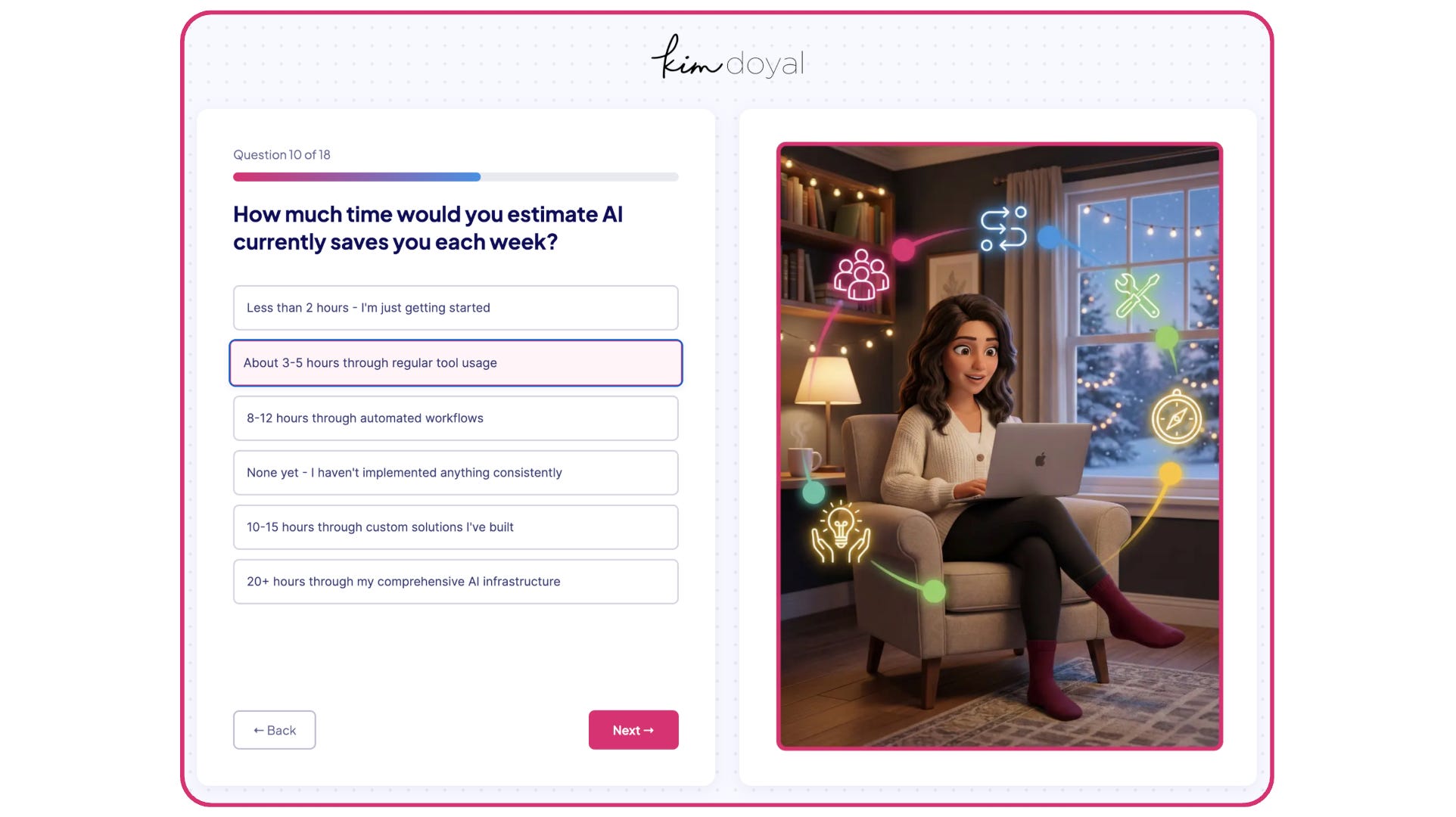
I spent quite a bit of time iterating on the user experience and how this quiz would fit into my business's ecosystem.
In other words, does this lead to a natural next step?
To get the PDF download & custom results, someone has to opt in at the end of the quiz. I’m using Kit to send the detailed follow-up. I’ve set it up so that unique fields are sent to the subscriber’s record (beyond name and email). This way, I can customize the follow-up sequence to the individual’s results.
I’m now editing the email sequence and setting up the Kit elements that will “call” that information into the email for the user.
My approach has been far more methodical this time.
And… I’ll test this, measure what’s working, edit questions, refine the results, and adjust emails once it’s been out in the wild for a while.
What This Means for You
If you’ve been thinking, “I should build something with AI,” here’s what I want you to know:
Your first build doesn’t have to be perfect. In fact, it won’t be perfect.
But that’s not the point.
The point is starting. Getting something functional. Learning what works and what doesn’t. And then - this is the important part - going back and rebuilding it better.
That’s the real skill. Not building once, but building with intention. Building with strategy. Building with the clarity that only comes from doing it, making mistakes, and doing it again.
*It can be an app, a quiz, an agent, a workflow, or simply a tool for you to use that helps with your own workflows.
SPARK Spotlight 🔥
You know you’re on the right path when you find someone who makes you think in a whole new way about how you’re doing something.
That’s what this week’s newsletter and its author have done for me. Even if her prompts send me down a rabbit hole, lol.

Per the author,
- Robots Ate My Homework is “AI workflows for creators who refuse to be boring. Get complete systems + strategic depth + human creativity. Yes, the robots ate your homework—but we kept the good parts.”A Little Brainpower 🧠
More goodness from Gemini 3. “The Gemini 3 “YouTube Hack” that feels like pure magic” by
.Building AI workflows? “Make.com vs n8n: What Most Reviews Get Wrong About These AI Automation Platforms,” by
& .A great year-end checklist: “Eight Things You Should Do Now To Set Up Your Newsletter In The New Year.”
Tool Time ⚒️
Design: a design toolkit made by designers for designers, offering a range of features for design, prototyping, collaboration, and handoff. Try Sketch free here.
SEO: A tool that monitors how AI models like ChatGPT, Claude, and others mention, rank, and describe your brand. Check out Prompt Signal here. Check out Prompt Signal here.
YouTube: A comprehensive YouTube competitor analysis tool. See exactly what’s working for successful channels in your niche and replicate their winning strategies. Try OutlierKit free here.
Notes: Connect every note, idea, and link on one simple canvas. Then bring in your favorite AI model to help you refine. Try ThreadDeck free here.
Yep, pretty much!
(read the text above the fireplace, lol)

I hope you’re all having a wonderful week. I’m a day early this week because I’m taking Thursday off to be with family, but I’ll be back next week with a deep dive into the quiz build process (and probably some stories about my Dad’s Thanksgiving commentary 😂).
If you’re in the States & celebrating, I hope you have a wonderful Thanksgiving.
If you’re thinking about building something with AI, start small. Pick one thing. Build it. Learn from it. Then make it better. That’s the path forward.
With coffee & kindness,
Kim
P.S. The quiz launches soon. I’ll share the link once the email sequences are dialed in. No point in collecting emails if I can’t follow up properly.
I've been trying to apply your advice to what I am currently building, Kim. To be honest, it's taken the pressure off with the realisation this might not be the version that goes public - it's my sandbox, I get to play, test, break, build again. I'm trying to focus on starting anyway and figuring out the next thing one step at a time, it's rather freeing!
The Kit integration detail is 10/10.
Most people building AI tools forget that the tool itself is just one piece.
The real value is in what happens AFTER someone uses it.
Thank you for sharing your evolution of thinking, Kim.
Very helpful.